Pastor Andres’ passion for Kierkegaard is not what directed his path to ministry at Vinje, but he has, of course, managed to find a very unique story about an interesting connection between Vinje and Kierkegaard which he shares with us here…
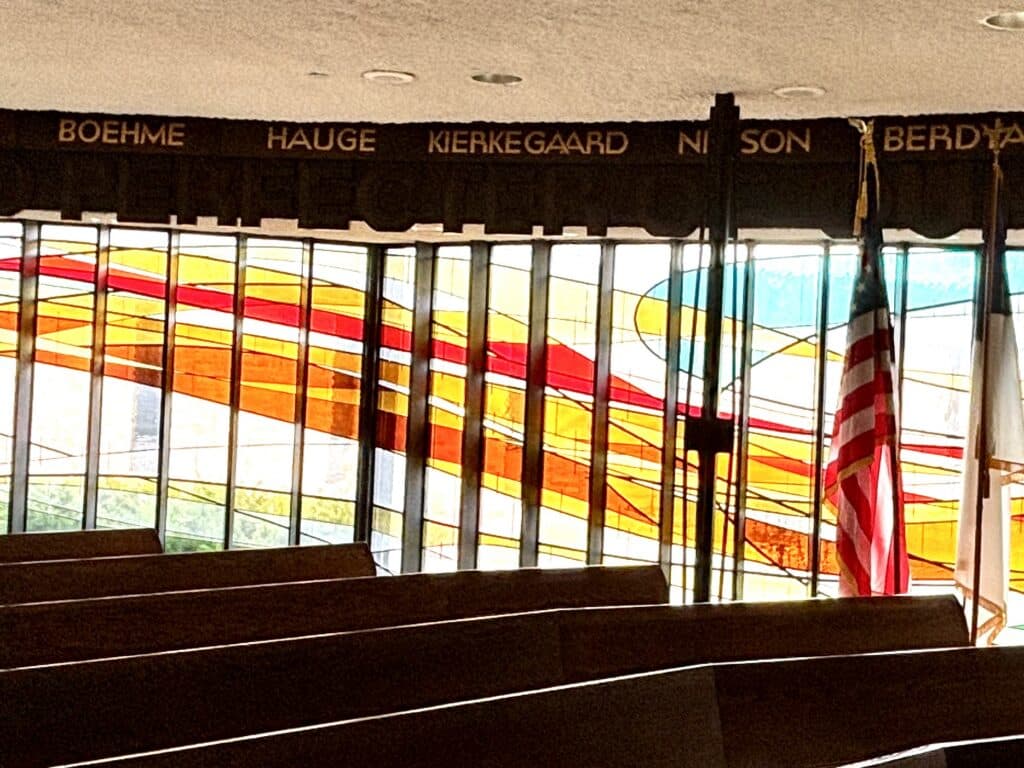
On May 5, Søren Kierkegaard would have turned 213 years old. He is the only Dane named on the frieze in the sanctuary of Vinje. For me, as someone who has spent years studying his work—long enough to write a dissertation on it—it does not feel like an accident that I now serve as a pastor in a place where his name is literally inscribed into the space of worship.
As far as I know, only one other church in the United States features Kierkegaard so prominently: First Lutheran Church of West Seattle, where a bronze statue of him was dedicated in 2013 to mark the 200th anniversary of his birth.
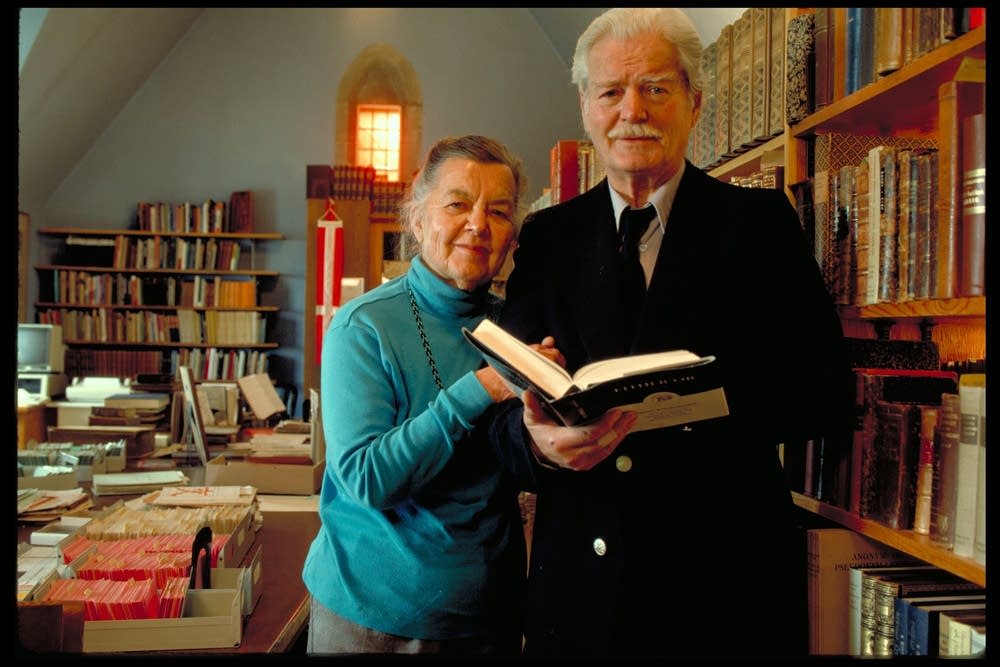
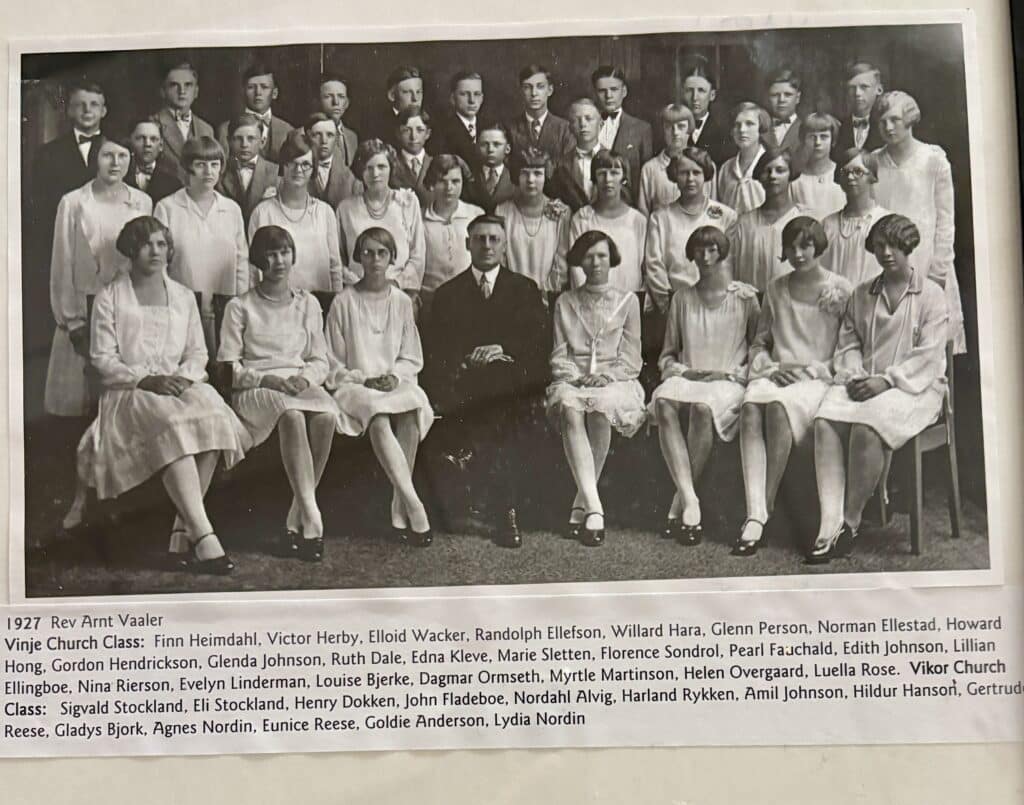
I am still curious how the names on Vinje’s frieze were originally chosen. In Kierkegaard’s case, however, the connection may be close to home. Howard V. Hong—who, together with his wife Edna Hong, translated most of Kierkegaard’s writings into English—grew up at Vinje. Hong taught at St. Olaf College for forty years, from 1938 to 1978, and his life story is deeply rooted in this region.
He was born in 1912 in Wolford, North Dakota, where his father had gone from Willmar to start a bank along a developing railroad line tied to the grain trade. The venture prospered enough that even a nearby grain elevator bore the family name—a detail that amused Hong later in life. Before Howard began school, the family returned to Willmar, where his father became president of the Kandiyohi County Bank. Hong grew up there, always thinking of Willmar as home and of Vinje as his church.
A precocious student, he finished high school at sixteen and briefly attended business college in Minneapolis before returning to Willmar to work—dividing his time between the bank and a food distribution warehouse. In 1930, he enrolled at St. Olaf College, where he studied English, managed the student newspaper, and began reading widely. It was through Henrik Ibsen that he first encountered Kierkegaard’s name. A biography noted Ibsen’s debt to the Danish thinker, and the name stirred a memory: his father had once mentioned a local farmer who owned books by Kierkegaard. That small thread led Hong to begin reading whatever Kierkegaard he could find in English.
He went on to graduate study at the University of Minnesota, earning his PhD in 1938. That same year, he married Edna, just one day after her own graduation from St. Olaf. Within months—after he had joined the St. Olaf faculty and she had typed his dissertation—they set off together for Denmark, hitchhiking to New York and sailing to Copenhagen to study both Kierkegaard and the Danish language.
It was there that Edna famously joked she had become a “bigamist,” now sharing her life with both her husband and Kierkegaard. In truth, that remark captured something real: their work became a shared vocation. She learned Danish alongside him, and together they undertook what would become one of the most significant translation projects in modern philosophy.
Their first major effort was the seven-volume Journals and Papers, published between 1967 and 1978. They followed it with the monumental 26-volume Kierkegaard’s Writings, completed in 2000 and published by Princeton University Press—a body of work that has shaped how generations of English-speaking readers encounter Kierkegaard.
Hong’s dedication extended beyond translation. After Kierkegaard’s death in 1855, his personal library had been dispersed at auction. Using a published catalog and his own meticulous records, Hong spent years attending book auctions and searching antiquarian shops across Europe, trying to reconstruct that lost collection. The books he gathered, along with microfilms and related materials, were donated by the Hongs to St. Olaf in 1976, forming what is now the Howard V. and Edna Hong Kierkegaard Library, housed since 2021 in its own building, Steensland Hall.
Edna died in 2007 and Howard in 2010, but their legacy continues—above all through their translations, which remain the standard gateway into Kierkegaard’s work, and through the ongoing life of the Kierkegaard Library. This June, it will host its 10th International Kierkegaard Conference, a gathering I hope to attend.
And so, when I look up at the name “Kierkegaard” on the frieze at Vinje, I do not just see a distant Danish philosopher. I see a story that runs through this place: from a young man in Willmar discovering a name in a book, to a lifetime of scholarship that carried that name across languages and generations—and, in a quiet way, brought it back home again.